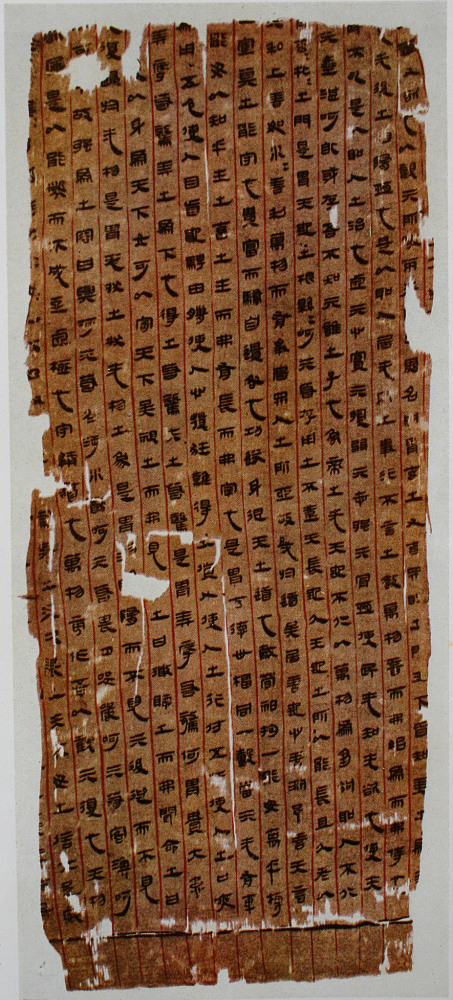
Tao Te Ching
Introduction
The Tao Te Ching, also known as Dao De Jing, is a classic Chinese text traditionally credited to the sage Lao Tzu, who is regarded as the founder of Taoism. Written in the sixth century BC, the Tao Te Ching is a fundamental scripture of Taoist philosophy, which emphasizes simplicity, humility, and harmony with nature, offering profound wisdom on life, governance, and the universe.
Historical Context and Authorship
The Tao Te Ching is believed to have been composed over 2,500 years ago during the Zhou Dynasty, a period marked by significant philosophical and cultural development in China. Laozi, whose name means "Old Master," is traditionally considered the author of the text. According to legend, he was an archivist in the imperial court who, disillusioned with the moral decay of his era, decided to leave society. As he was departing, a gatekeeper asked him to record his teachings, resulting in the creation of the Tao Te Ching.
Philosophical Themes
Tao and Te
The title Tao Te Ching can be translated as "The Classic of the Way and Virtue." The concept of "Tao" (Dao) represents the ultimate and unnamable force underlying the universe, guiding the natural order of life. "Te" (De) refers to the virtue or power that arises from living in harmony with the Tao. Together, these concepts underpin the text's philosophical teachings.
Key Teachings
The Tao Te Ching consists of 81 short chapters, offering guidance on various aspects of life, from personal conduct and leadership to spirituality and metaphysics. Some of its core teachings include:
Wu Wei (Non-action): The principle of effortless action, where one aligns with the natural flow of life, allowing things to unfold without force or struggle.
Simplicity and Humility: Advocating for a life of simplicity and humility, the Tao Te Ching suggests that these virtues lead to contentment and peace.
Balance and Duality: The text explores the dual nature of reality, emphasizing the interdependence of opposites, such as light and dark, life and death, and good and bad.
Global Impact and Translations
Its universal themes have resonated with people worldwide, inspiring countless interpretations and adaptations across different cultures.
Cultural and Artistic Representation
The Tao Te Ching has inspired various artistic expressions, from traditional Chinese calligraphy and painting to contemporary literature and film. Artists like Li Hongtao and Cheng Qiang have drawn on its themes to create abstract works that explore the interplay of form and formlessness, reflecting the text's philosophical ideas.
Modern Relevance and Studies
Today, the Tao Te Ching continues to be a subject of scholarly study and public interest, with international symposiums and research centers dedicated to exploring its teachings and relevance in addressing contemporary global challenges, such as environmental sustainability and social harmony.
In conclusion, the Tao Te Ching remains a timeless source of wisdom, offering insights into living harmoniously with oneself, others, and the world. Its teachings on humility, simplicity, and balance continue to inspire individuals and societies seeking a deeper understanding of the human experience and the universe. Photo Gallery(3 pictures)CategoriesChinese PhilosophyTagClassics of Chinese StudiesTaoismRelatedLao ZiZhuang ZiLaojun MountainCheng QiangCatalogue1. Introduction2. Historical Context and Authorship3. Philosophical Themes4. Global Impact and Translations5. Cultural and Artistic Representation6. Modern Relevance and Studies- - - []








